A draft Brexit deal between the UK and the EU has been agreed.

A draft Brexit deal between the UK and the EU has been agreed.

It will have to be agreed by the UK Government and Parliament. It will also have to be agreed by the remaining 27 countries of the EU.

Update. On Wednesday 14th November 2018 the UK Cabinet agreed to the draft EU withdrawal document.
The EU (Withdrawal) Bill receives Royal Assent.

The EU (Withdrawal) Bill receives Royal Assent.

On Wednesday 27th June 2018 Queen Elizabeth II gave the Royal Ascent to the EU (Withdrawal) Bill which now becomes an Act and passes into UK law.

The Act ensures that current EU law becomes entwined with UK law allowing for an orderly exit from the EU since all requisite laws will be in place.

It is expected around 800 pieces of secondary legislation will be needed. The Government will use powers in the Bill to repeal the European Union Act 2011 as agreed by Parliament.

Theresa May pledges to set EU leaving date in law.

Theresa May pledges to set EU leaving date in law.

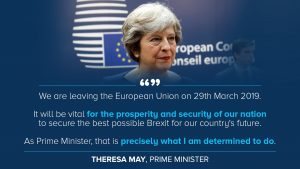
Prime Minister May says she will place the date that the UK leaves the EU (Brexit) into law. The date will be 11pm on Friday March 29 2019.


May pledges to enshrine leaving the EU date in law.

Theresa May returned as Prime Minister with a minority Government.

Theresa May returned as Prime Minister with a minority Government.

Following the General Election of Thursday 8th June 2017 no party managed to win a Parliamentary majority.
Theresa May lost seats unexpectedly to the Liberal Democrats and Labour.

The final result:-

Con. 42.4%.
Lab. 40%.
LibDems. 7.4%.
SNP. 3.0%.
UKIP. 1.8%.
Greens. 1.6%.

May was able to form a Government and remain Prime Minister after the Conservatives formed a coalition with the Democratic Unionist Party (DUP) which gained 10 seats giving her the required majority of MPs of 328.

Prime Minister wins Fixed Term Parliament Act vote.

Prime Minister wins Fixed Term Parliament Act vote.

On Tuesday 19th April 2017 the Prime Minister Theresa May introduced a motion to allow for Parliament to be dissolved, and a General Election called, under the Fixed Term Parliament Act 2011.

The Government won the vote by 533 votes to 13 allowing a General Election to be held on Thursday 8th June 2017.

Theresa May calls for General Election.

Theresa May calls for General Election.

The Prime Minister will introduce a motion in the house on Wednesday 19th April 2017 to call for a General Election on 8th June 2017.

She will need a majority vote of two thirds of MPs in Parliament to override the Fixed Term Parliament Act.

Prime Minister Theresa May triggers Article 50.

Prime Minister Theresa May triggers Article 50.

At 12.30pm on Wednesday 29th March 2017 a letter triggering the exit from the European Union by the United Kingdom was handed to the EU President Donald Tusk in Brussels.

The UK will now formally leave the EU in two years. During this time the UK will try and create an acceptable deal with the remaining 27 countries of the EU.

The only UKIP MP is to quit the party.

The only UKIP MP is to quit the party.

Douglas Carswell, the only UKIP MP, who defected from the Conservative Party in 2014, is quitting UKIP to become an independent MP for Clacton.

He says the split is amicable and that he he is leaving because he feels his job is done at UKIP. Meaning that he is now certain that Brexit will be completed.

He is not crossing the floor of the Commons so no by-election will be needed.

EU summit to be held on 29th April 2017 to discuss Brexit.

EU summit to be held on 29th April 2017 to discuss Brexit.

The remaining 27 EU members will meet for a summit to discuss Brexit a month after Article 50 is triggered.

Downing Street announce Article 50 will be triggered on Wednesday 29th March 2017.

Downing Street announce Article 50 will be triggered on Wednesday 29th March 2017.

This means that the official negotiations for the UK to leave the European Union can now begin with a result required by March 29th 2019.